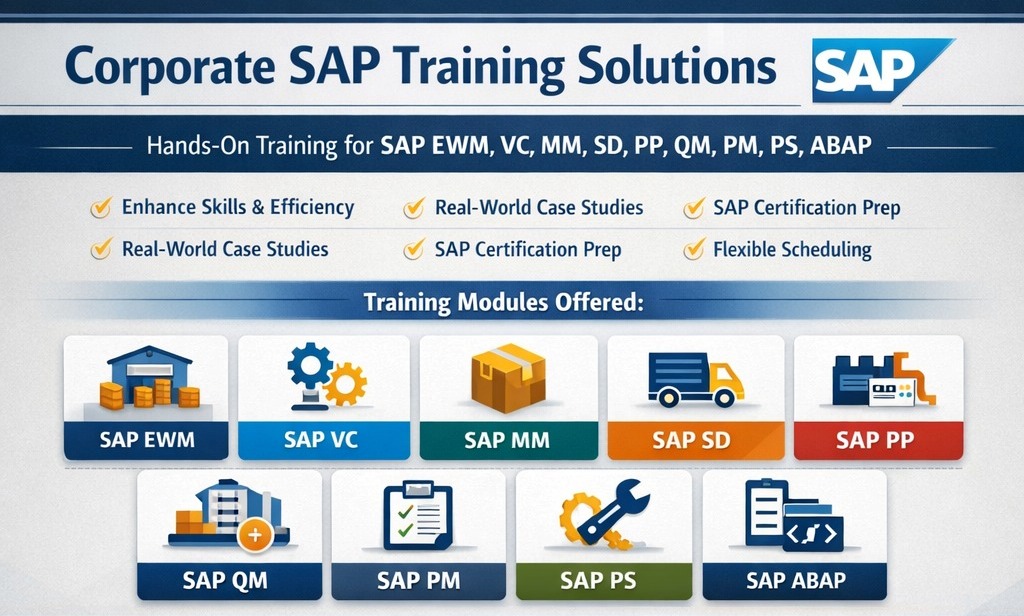
1. Training Objective Equip participants with practical and theoretical knowledge in specific SAP modules. Enable employees to efficiently execute business processes using SAP. Develop hands-on skills through simulations, exercises, and case studies. Prepare employees for SAP certification (optional) in respective modules.
2. Target Audience SAP end-users, consultants, business analysts, and project team members. IT professionals involved in SAP implementation or support. Managers and executives looking to understand SAP capabilities in business processes.
3. Training Modules & Coverage A. SAP EWM (Extended Warehouse Management) Overview of SAP EWM architecture and integration. Warehouse structure, storage types, and process types. Inbound/outbound processes and internal warehouse movements. Cross-docking, slotting, and labor management. Reporting and monitoring in SAP EWM. Hands-on exercises: creating storage bins, inbound/outbound orders, inventory postings. B. SAP VC (Variant Configuration) Basics of configurable materials and dependencies. Configuration profiles and class assignment. Pricing in variant configuration. Integration with MM, SD, and PP. Exercises: creating configurable products, defining characteristics and constraints. C. SAP MM (Materials Management) Procurement process: Purchase Requisition → Purchase Order → Goods Receipt → Invoice Verification. Master data: Material Master, Vendor Master. Inventory Management & Valuation. Reporting and analytics in MM. Hands-on exercises: create purchase orders, post goods receipts, run stock reports. D. SAP SD (Sales & Distribution) Overview of order-to-cash process. Master data: Customer, Material, Pricing, Conditions. Sales order processing, delivery, billing, and credit management. Integration with MM and FI. Exercises: create sales orders, deliveries, invoices, and pricing simulations. E. SAP PP (Production Planning) Overview of production processes. Master data: Material BOM, Work Center, Routing. Demand management, MRP, and production orders. Capacity planning and shop floor control. Exercises: create BOMs, simulate MRP, create production orders. F. SAP QM (Quality Management) Quality planning, inspection, and control. Master data: Quality Info Record, Inspection Plan, Sampling Procedures. Quality notifications, audit management. Integration with MM, PP, and SD. Exercises: create inspection plans, perform quality inspections, generate quality reports. G. SAP PM (Plant Maintenance) Overview of maintenance processes: preventive, corrective, and breakdown. Master data: Equipment, Functional Location, Maintenance Plans. Work orders, notifications, and reporting. Exercises: create maintenance plans, generate work orders, monitor maintenance tasks. H. SAP PS (Project System) Project structure: WBS, Networks, and Activities. Project planning, budgeting, and monitoring. Integration with MM, SD, and FI. Exercises: create projects, plan resources, track progress and costs. I. SAP ABAP (Programming & Customization) ABAP programming basics: Data Dictionary, Reports, Module Pools. User exits, BADI, and enhancement frameworks. ALV reports, Smart Forms, and SAP Scripts. Hands-on exercises: create simple reports, enhance standard programs, develop forms.
4. Training Methodology Instructor-led sessions (onsite/online). Hands-on exercises in a live SAP sandbox environment. Real-life business scenarios and case studies. Assessments and knowledge checks at regular intervals. Support for queries post-training via forums or emails.
5. Duration & Schedule Typically 3–5 days per module (flexible based on participant level). Can be customized into 2-week intensive programs covering multiple modules. Daily 3–6 hours depending on complexity and participant background.
6. Training Materials Module-specific training guides and eBooks. Pre-configured SAP sandbox system access for practice. Presentation decks, process flow charts, and sample exercises. Access to recorded sessions for later reference.
7. Certification & Assessment Optional SAP certification preparation. Module-end tests and practical exercises. Training completion certificate provided by the organization/training partner. 8. Advantages of Corporate SAP Training Faster onboarding and upskilling of employees. Improved process efficiency and accuracy in SAP usage. Reduced dependency on external consultants. Customizable to specific company processes and industry needs.